Guy Benson offers a quick primer on the GOP 2015 budget proposal put forward by House Budget Committee Chairman Paul Ryan.
Entitled "The Path to Prosperity," it (among other things) balances the budget within 10 years, reduces federal spending by $5.1 trillion by slowing spending growth, affords flexibility to states by block-granting Medicaid, strengthens work requirements for able-bodies adults receiving welfare and food stamps, and closes deductions and loopholes in exchange for a simpler tax system and lower tax rates for individuals and corporations. It also addresses social security and Medicare reforms. (Read Benson's primer for more.)
In contrast, Benson points out, the Senate Democrats have produced no budget proposal for 2015 whatsoever. President Obama's 2015 budget proposal never balances (ever), increases spending $1 trillion beyond the unsustainable current trajectory (more steeply and sooner than the above chart shows), raises taxes by $1.8 trillion, and makes no attempt at reforming Social Security and Medicare entitlements.
Benson concedes the budget proposal has "zero chance of becoming law, but its very existence makes clear that Ryan and his colleagues take their responsibilities — and the law — seriously."
Showing posts with label federal budget. Show all posts
Thursday, April 3, 2014
Wednesday, March 13, 2013
Competing Budgets: House, Senate, White House
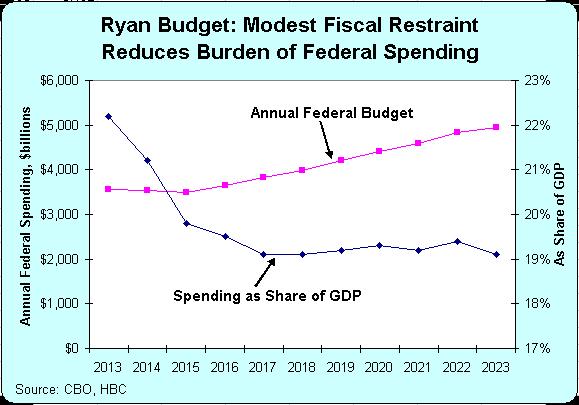
Rep. Paul Ryan (R-WI), chairman of the House Budget Committee, released his proposed budget this week. In addition to no new tax hikes, key features include:
- comprehensive tax reform that would close loopholes and consolidate income tax rates into two brackets: 10% and 25%;
- energy reform that would approve the Keystone Pipeline, open federal land to natural gas development (a supply equal to 90 years of America's needs), create thousands of jobs, deliver millions of new dollars to government treasuries, and put the U.S. on path to full energy independence;
- health care reform that includes repealing Obamacare and strengthening Medicare;
- welfare reform that incentivizes states to help people off welfare rolls and on to payrolls; limiting federal government spending increases to 3.4% per year rather than 5%; and
- a balanced federal budget by 2023.
The president's budget, now two months behind schedule, is due out in April.
As you can see in the chart, federal spending grows by an average of 3.4 percent annually, and that modest bit of fiscal discipline is enough to reduce the burden of government spending to 19.1 percent of economic output by 2023.Per Mitchell, "the Ryan Budget is a step in the right direction, but much more will be needed to restore limited, constitutional government."
It’s also good news that the Ryan Budget calls for structural reform of entitlement programs, including Medicaid block grants and Medicare premium support. The budget also assumes the repeal of the costly Obamacare program.
And there’s also some good tax policy. Not bold tax reform like a flat tax, but top tax rates would be reduced to 25 percent and many forms of double taxation, like the death tax and capital gains tax, presumably would be reduced or eliminated.
Wednesday, March 21, 2012
The Ryan Budget Plan
House Budget Chairman Paul Ryan's federal budget is a "plan to slash trillion dollar deficits and revive reforms to the Medicare program," with options floated last year by Democrats, reports Newsmax. "The raw material is there," concludes Michael Barone, "for bipartisan majorities for reform—if the president goes along." Just how far apart are the Ryan and Obama budget plans? Not even in the same universe, according to Don Surber's chart:
This chart from James Pethokoukis
Monday, February 13, 2012
Lawless Disregard for Federal Budget Requirement
"Two top Democrats in Congress say the legislature doesn't really need to pass a budget," reports Investor's Business Daily.
"The fact is, you don't need a budget," [House Minority Whip Steny Hoyer] said last Tuesday. We can adopt authorization policies without a budget."Au contraire, says IBD.
On Friday, Senate Majority Leader Harry Reid said: "We do not need to bring a budget to the floor this year. It's done, we don't need to do it."
Actually, "the fact is," Congress is required under the Congressional Budget and Impoundment Control Act of 1973 to pass a spending plan and then have it scored by the Congressional Budget Office and signed by the president. That none of this happens suggests a level of disrespect for the law and the people found only among criminals.Note: The Democratic-controlled Senate hasn't passed a budget in nearly 3 years.
Subscribe to:
Posts (Atom)